
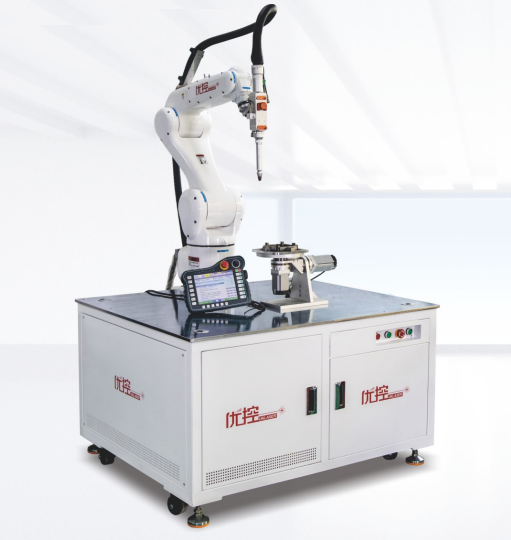
Robot 3D Platform Laser Welding Machine
Categories: All, Laser Welding Machine
Brand: Robot 3D Platform Laser Welding Machine
Robot 3D Platform Laser Welding Machine
Product Overview
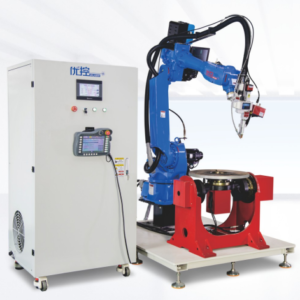
The Robot 3D Platform Laser Welding Machine is a premium, multi-axis collaborative laser welding system engineered by Youkong that represents the pinnacle of automated welding platform technology. This machine uniquely combines the spatial freedom and flexibility of a robotic manipulator arm with the structural stability and precision of a dedicated three-dimensional platform workstation — creating a welding system that delivers capabilities far beyond what either a standalone robotic arm or a conventional fixed-axis welding machine can achieve independently. The term "three-dimensional platform" — is central to understanding what makes this machine special. While most laser welding machines operate on one, two, or at most three linear axes, the Robot 3D Platform Laser Welding Machine operates in true three-dimensional space, with the robotic manipulator providing full spatial freedom of movement above a customizable workbench platform. This means the welding head can approach any joint, on any surface, from virtually any angle — enabling the machine to handle the most geometrically complex welding tasks in modern industrial manufacturing. This system is designed for manufacturers who face welding challenges that conventional machines simply cannot solve — complex 3D weld paths on formed or assembled components, large workpieces that require extensive reach, multi-pass welds on irregular geometries, and applications where both precision and power must be simultaneously maximized. It is a solution built for the most demanding welding environments, where quality, versatility, and reliability are non-negotiable.The 3D Platform Concept — A New Dimension in Welding
To understand the significance of the 3D platform architecture, it is worth comparing it to the alternatives:Conventional Fixed-Axis Laser Welders
Standard laser welding machines — whether handheld, gantry, or simple CNC platforms — operate on fixed linear axes (X, Y, Z). They are excellent for flat seam welding, straight-line joints, and simple geometric patterns on flat workpieces. However, they are fundamentally limited when it comes to:- Welding on curved or formed surfaces
- Accessing joints on assembled 3D structures
- Changing the torch angle to optimize penetration on angled joints
- Processing large or irregularly shaped workpieces that exceed the machine's fixed working envelope
Standard Robotic Welding Arms (Without Platform)
A robotic arm alone provides excellent spatial freedom but lacks the structural rigidity and workpiece positioning capability of a dedicated platform. Without a well-designed workbench, fixturing and positioning large or complex workpieces becomes a significant challenge — limiting the practical utility of the robotic arm's spatial freedom.The Robot 3D Platform Solution
The Robot 3D Platform Laser Welding Machine combines the best of both worlds:- The robotic manipulator provides full 3D spatial freedom, multi-axis articulation, and intelligent motion control
- The 3D platform workbench provides a stable, customizable, and precisely referenced workspace for workpiece fixturing and positioning
- Together, they create a collaborative welding cell where the robot and the workpiece positioning system work in concert to achieve weld quality and geometric capability that neither could achieve alone
Laser Power Range — 1000W to 4000W
The Robot 3D Platform Laser Welding Machine is available in a broad power range of 1000W to 4000W, providing exceptional flexibility to configure the system for a wide spectrum of welding applications — from precision thin-sheet joining to heavy-duty thick-plate welding.Understanding the Power Range
1000W – 1500W (Lower Power Range) At the lower end of the power spectrum, the machine delivers precise, controlled energy input ideal for:- Thin sheet metal welding (0.5mm – 2mm) where heat management is critical to prevent distortion and burn-through
- Precision component welding in electronics, medical devices, and fine instrumentation
- Aesthetic welds on visible surfaces where a narrow, clean weld bead with minimal heat-affected zone is essential
- Welding of heat-sensitive materials or alloys where excessive heat input could compromise material properties
- Fine seam welding on stainless steel decorative components, kitchen equipment, and precision housings
- General-purpose structural welding on components from 1mm to 5mm thickness
- Automotive structural components, brackets, and subassemblies
- Elevator and architectural metalwork requiring consistent, high-quality weld beads
- Home appliance manufacturing where speed and quality must both be optimized
- Multi-pass welding sequences on medium-gauge materials
- Deep penetration welding on thick plates up to 8mm in a single pass
- High-speed welding of medium-gauge materials where maximum throughput is the priority
- Welding of highly reflective materials such as aluminum and copper alloys, which require higher power to overcome their reflectivity and achieve consistent fusion
- Heavy structural fabrication, industrial machinery components, and large assembled structures
- Applications requiring high heat input for full penetration welds on thick-walled tubular structures
Welding Thickness Capability — 0.5mm to 8mm
The machine handles material thicknesses across the full range of 0.5mm to 8mm, covering virtually every sheet metal and light structural welding application in modern manufacturing: 0.5mm – 1.5mm (Ultra-thin to Thin) This range demands the most precise control of heat input and laser parameters. The Robot 3D Platform machine's intelligent power modulation and precise robotic motion combine to deliver clean, consistent welds on ultra-thin materials without burn-through, warping, or discoloration. Applications include fine electronic housings, thin decorative panels, precision instrument components, and lightweight appliance shells. 1.5mm – 4mm (Standard Industrial Range) This is the most common thickness range in industrial fabrication and represents the core competency of the machine. At these gauges, the system delivers high-speed, high-quality welds with excellent penetration, minimal spatter, and clean bead profiles — ideal for automotive panels, elevator components, structural brackets, HVAC assemblies, and general fabricated structures. 4mm – 8mm (Heavy Gauge) At the upper end of the thickness range, the machine's high-power configurations (2500W–4000W) enable deep penetration welding of heavy gauge materials. This capability extends the machine's application range into heavier structural fabrication, thick-walled pressure vessel components, heavy machinery parts, and industrial equipment manufacturing — areas where many conventional laser welders cannot reach.Repeat Positioning Accuracy — ±0.05mm
The repeat positioning accuracy of ±0.05mm is one of the most technically significant specifications of the Robot 3D Platform Laser Welding Machine. This half-tenth-of-a-millimeter precision is achieved through the combination of:- High-resolution servo motor encoders on every joint of the robotic manipulator arm
- Advanced motion control algorithms that continuously compensate for mechanical compliance, thermal expansion, and dynamic loading during operation
- Rigid structural construction of both the robotic arm and the 3D platform workbench, minimizing vibration and flexure during high-speed motion
- Regular calibration protocols embedded in the control system to maintain accuracy over the machine's operational life
What ±0.05mm Means in Practice
To contextualize this precision level, 0.05mm is approximately half the width of a human hair. In welding terms, this means:- Weld placement consistency: Every weld bead is deposited in exactly the same position on every part, cycle after cycle. On parts with tight joint gaps (≤0.3mm), this level of accuracy is essential to ensure the laser beam consistently hits the joint rather than missing it or impacting only one side.
- Multi-pass weld consistency: For thick materials requiring multiple weld passes, ±0.05mm accuracy ensures each successive pass is precisely placed relative to the previous one — critical for achieving full fusion and the required weld profile.
- Complex path fidelity: On intricate 3D weld paths with multiple direction changes, tight curves, and varying approach angles, ±0.05mm accuracy ensures the actual weld path matches the programmed path with exceptional fidelity — preserving the dimensional integrity of the finished assembly.
- Batch-to-batch repeatability: Across thousands of production cycles, the machine maintains this accuracy level — ensuring that the first part welded and the ten-thousandth part welded are dimensionally identical. This is the cornerstone of reliable, high-quality automated production.
Robotic Manipulator — 930mm Arm Length (Optional Configurations)
The robotic manipulator is the kinematic heart of the system, with a standard arm length of 930mm and optional extended configurations available. This multi-axis articulated arm provides:Full Spatial Freedom
The manipulator's multiple rotational joints — typically 6 axes of freedom — allow the welding head to be positioned and oriented at virtually any point in three-dimensional space within its working envelope. This means the machine can:- Weld on curved surfaces: The arm continuously adjusts its orientation to maintain the optimal torch angle relative to the tangent of the curved surface — ensuring consistent penetration and bead profile even on complex geometries
- Access recessed joints: The arm can reach into concave structures, inside corners, and recessed areas that are inaccessible to fixed-axis machines
- Follow complex 3D seam paths: Weld seams that travel across multiple planes, change direction repeatedly, and vary in orientation are no challenge for the 6-axis manipulator
- Perform circumferential welds: Circular, oval, or irregular closed-loop weld paths on pipe ends, flanges, and circular assemblies are executed smoothly and consistently
Optional Arm Configurations
The availability of optional arm configurations means the machine can be specified with extended reach for larger workpieces or a more compact arm for tighter working envelopes — giving customers the flexibility to optimize the system for their specific production requirements.Programmable Motion Control
The manipulator is fully programmable through multiple methods:- Teach pendant programming: Direct manual guidance of the arm to key positions along the weld path, with the control system automatically generating smooth interpolated motion between taught points
- Offline programming software: Full 3D simulation and programming of complex weld paths on a computer, with collision detection, cycle time optimization, and program validation before uploading to the machine
- Parametric welding programs: Pre-defined program templates for common weld types (butt welds, fillet welds, lap joints, corner joints) that can be quickly adapted to new part geometries — accelerating programming time for new products
- Program library: Unlimited weld programs can be stored in the system memory and recalled instantly via the operator interface — enabling rapid product changeover with no physical retooling
Customizable Workbench — The Platform Foundation
The customizable workbench is an equally important component of the Robot 3D Platform Laser Welding Machine and a key differentiator from standard robotic welding systems. The workbench serves as the foundation upon which workpieces are fixtured, positioned, and held during welding — and its customizability is a major advantage for manufacturers processing diverse part types.Workbench Customization Options
- Size and dimensions: The workbench can be configured to the exact size required for the customer's workpiece range — from compact tables for small precision components to large platforms for sizable structural assemblies
- Material and surface treatment: Workbench materials and surface treatments can be specified based on the thermal, chemical, and mechanical demands of the application
- Fixturing systems: Custom fixture designs can be integrated directly into the workbench design — ensuring parts are positioned and clamped accurately and repeatably for every production cycle
- Rotary or tilting axes: For circumferential welding or welding on multiple faces of a workpiece, the workbench can be equipped with rotary positioners or tilting axes that work collaboratively with the robotic arm — dramatically expanding the machine's capability for complex multi-face welding
- Multi-station configurations: For high-volume production, the workbench can be configured with multiple fixturing stations — allowing one station to be loaded/unloaded while the robot welds on the other, maximizing machine utilization and production throughput
The Collaborative Platform Advantage
When the robotic manipulator and the workbench positioning system operate collaboratively — with the control system coordinating their motion simultaneously — the system achieves a level of welding capability that goes far beyond what the robot arm alone can deliver:- Synchronized rotation and welding: The workpiece rotates on the platform positioner while the robot maintains the optimal welding position and angle — enabling seamless circumferential welds on cylindrical or curved components without stopping and repositioning
- Continuous multi-face welding: The platform tilts the workpiece to present successive faces to the robot — allowing all welds on a complex assembly to be completed in a single setup without operator intervention
- Optimal torch angle maintenance: As the workpiece is repositioned by the platform, the robot continuously adjusts its arm configuration to maintain the ideal torch angle for the current weld — ensuring consistent penetration and bead quality across all joint orientations
Multi-Axis Collaborative Welding — The System's Defining Capability
The defining characteristic of the Robot 3D Platform Laser Welding Machine is its multi-axis collaborative welding capability — the ability to simultaneously coordinate the motion of the robotic arm and the workbench positioning system to achieve welding results that are impossible with conventional single-system approaches. In a collaborative multi-axis welding operation:- The robotic arm controls the position, orientation, and motion of the welding head — managing the laser beam delivery, torch angle, travel speed, and weld path
- The workbench positioning system simultaneously controls the position and orientation of the workpiece — rotating, tilting, or translating the part to continuously present the optimal welding position to the robot
- The unified control system coordinates both motions in real time — ensuring perfect synchronization between arm and platform so that the relative motion between the welding head and the workpiece follows the programmed weld path exactly
- Gravity-optimized welding positions: The workpiece is always oriented so that the weld pool is in the optimal position relative to gravity — preventing sagging, porosity, and irregular bead profiles that occur when welding in difficult positions
- Continuous access to all weld joints: On complex assemblies with multiple weld joints on different faces and at different orientations, collaborative motion ensures the robot can access every joint without the need for manual repositioning of the workpiece
- Maximum travel speed efficiency: By distributing motion between the arm and the platform, the system can often achieve faster effective weld travel speeds than either system could achieve independently — improving cycle time and throughput
Advanced Laser Control & Process Technology
Beyond the mechanical capabilities of the robot and platform, the machine incorporates sophisticated laser control technology that elevates weld quality to the highest levels:Real-Time Power Modulation
The laser power can be modulated in real time during welding — automatically adjusting as the robot changes speed at corners, transitions between joint types, or encounters changes in material thickness. This prevents the over-heating that occurs at the start and end of welds and at direction changes — which are common sources of weld defects in systems with fixed power output.Seam Tracking (Optional)
Optional laser seam tracking sensors can be integrated to continuously monitor the joint position and automatically correct the weld path if the actual joint location deviates from the programmed path. This is particularly valuable when:- Part-to-part dimensional variation means joints are not always in exactly the same location
- Thermal distortion during welding causes the joint to move relative to its original position
- Long weld seams accumulate small positional errors that would otherwise cause the beam to miss the joint
Weld Quality Monitoring
Integrated monitoring systems can track key welding process parameters — laser power, travel speed, shielding gas flow, and thermal emission from the weld pool — in real time, flagging any deviations from the specified process window and enabling rapid identification of quality issues before defective parts leave the welding cell.Key Industry Applications
The Robot 3D Platform Laser Welding Machine's combination of power range, precision, 3D capability, and platform flexibility makes it a transformative solution across multiple industries:Automotive Manufacturing
Complex automotive body structures, chassis components, battery module housings for electric vehicles, fuel system assemblies, and powertrain components all benefit from the machine's combination of high power, 3D welding capability, and precision. The collaborative platform enables multi-face welding of complex automotive subassemblies in a single setup — dramatically reducing cycle time and handling costs.Aerospace & Defense
Lightweight alloy structures, titanium components, precision instrument housings, and structural brackets for aerospace applications demand the highest levels of weld quality and dimensional accuracy. The ±0.05mm repeatability and precise power control of the Robot 3D Platform machine deliver aerospace-grade weld quality consistently and reliably.New Energy & Battery Manufacturing
Battery module housings, energy storage enclosures, fuel cell components, and power electronics assemblies for electric vehicles and energy storage systems require clean, precise, leak-proof welds on aluminum and stainless steel. The machine's ability to handle thin aluminum sheets at lower power levels while maintaining ±0.05mm accuracy makes it ideal for new energy manufacturing.Heavy Industrial Equipment
At the 4000W power level, the machine delivers the deep penetration welding capability needed for heavy machinery frames, hydraulic system components, pressure vessels, and structural fabrications — where weld quality directly impacts structural integrity and operational safety.Medical Device Manufacturing
Medical device housings, surgical instrument components, implant structures, and sterile equipment enclosures require clean, spatter-free, precisely controlled welds that meet strict regulatory standards. The machine's precision and clean laser welding process produce medical-grade weld quality consistently.General Precision Fabrication
Custom architectural metalwork, precision industrial enclosures, scientific instrument housings, defense equipment components, and specialty fabricated assemblies of all types benefit from the Robot 3D Platform machine's combination of versatility, precision, and power.Advantages Over Alternative Welding Technologies
| Capability | Manual TIG/MIG Welding | Standard CNC Laser Welder | Standard Robot Welder | Robot 3D Platform Welder |
|---|---|---|---|---|
| 3D Weld Path Capability | Limited by operator skill | Limited to programmed axes | Good | Excellent |
| Positional Accuracy | Poor (operator-dependent) | ±0.1mm typical | ±0.05mm | ±0.05mm |
| Power Range Flexibility | Limited | Fixed configuration | Good | 1000W–4000W |
| Thickness Range | 0.5–8mm (variable quality) | Typically limited range | 0.5–8mm | 0.5–8mm |
| Complex Geometry Handling | Skilled operators required | Very limited | Good | Excellent |
| Workpiece Collaboration | Manual repositioning | None | Limited | Full collaborative platform |
| Consistency Across Batches | Poor | Good | Very Good | Excellent |
| Setup Flexibility | High (manual) | Low | Medium | High (customizable platform) |
Be the first to review “Robot 3D Platform Laser Welding Machine” Cancel reply
Reviews
There are no reviews yet.