
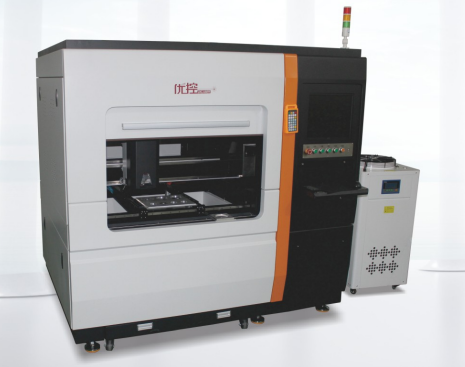
Precision Cutting Machine — Model UK-QG-M
Categories: All, Laser Cutting Machine
Brand: Precision Cutting Machine
Precision Cutting Machine — Model UK-QG-M
Product Overview
The UK-QG-M Precision Cutting Machine is a high-performance, fine-detail fiber laser cutting system engineered by Youkong that sets a new standard for dimensional accuracy, cut edge quality, and processing consistency in industrial laser cutting applications. Designed and built for manufacturers, engineers, and fabricators who operate in domains where cutting tolerances are measured in hundredths of a millimeter and where the quality of every cut edge directly impacts the performance, fit, and finish of the final product, the UK-QG-M is the definitive precision laser cutting solution in Youkong's product portfolio. The defining characteristic of the UK-QG-M — the quality that its name most directly communicates and that every specification reinforces — is precision. Not the general-purpose precision of a standard industrial laser cutter, but the exacting, uncompromising precision of a machine built from the ground up for applications where accuracy is the primary requirement, where ±0.03mm machine accuracy and ≤0.19mm kerf width are not aspirational targets but guaranteed performance specifications, and where every design decision — from laser wavelength selection to mechanical construction philosophy to cutting head technology — is made in service of achieving and sustaining the highest possible level of cutting accuracy and consistency. The UK-QG-M is positioned at the intersection of two worlds that have traditionally required separate, specialized equipment: the world of high-accuracy precision machining and the world of high-speed laser cutting. It brings the dimensional accuracy associated with precision machining — tight tolerances, consistent results, fine feature resolution — to the speed, flexibility, and material versatility of laser cutting technology. This unique positioning makes the UK-QG-M an indispensable tool for manufacturers in electronics, medical devices, precision instrumentation, aerospace components, fine mechanical parts, jewelry, watchmaking, and any other field where cutting precision is a non-negotiable production requirement. The machine is available in power configurations ranging from 500W to 2000W (with custom configurations available up to 2000W), operates at the precision-optimized laser wavelength of 1064nm, supports cutting areas up to 300×500mm (with larger custom configurations available), and achieves a guaranteed machine accuracy of ±0.03mm with a kerf width of ≤0.19mm — specifications that collectively define a cutting machine of exceptional technical caliber.Precision as a Design Philosophy — The Foundation of the UK-QG-M
To understand what makes the UK-QG-M genuinely different from standard industrial laser cutters — and why those differences matter profoundly for precision manufacturing applications — it is necessary to understand precision not just as a specification but as a design philosophy that permeates every aspect of the machine's architecture.Precision Demands Mechanical Excellence
The foundation of cutting precision is mechanical integrity. A laser cutting machine is, at its most fundamental level, a positioning system — it moves the laser beam (or the workpiece, or both) in a precisely controlled pattern to cut the desired shape. The accuracy of the resulting cut is only as good as the accuracy of this positioning. Every source of mechanical imprecision — structural flex under load, backlash in drive mechanisms, thermal expansion of machine components, vibration from cutting forces or environmental sources — directly translates into positional error in the cut. The UK-QG-M's mechanical construction reflects the understanding that precision cutting requires a mechanical platform of exceptional rigidity, stability, and thermal stability:- Rigid structural construction: The machine's frame and structural members are engineered for maximum rigidity — minimizing deflection under the forces of cutting head acceleration and deceleration, workpiece weight, and cutting reaction forces. A rigid structure is the mechanical foundation upon which all other precision-enabling technologies depend.
- High-precision linear motion systems: The axes of motion that position the cutting head relative to the workpiece use high-precision linear guide systems and precision ball screw or linear motor drives that minimize backlash, smooth out motion irregularities, and maintain tight positioning accuracy throughout the machine's working envelope.
- Thermal stability design: Temperature changes cause thermal expansion and contraction of machine components — a phenomenon that can cause dimensional errors in precision cutting if not properly managed. The UK-QG-M's structural design minimizes the sensitivity of cutting accuracy to ambient temperature variations, ensuring consistent performance across the range of temperatures encountered in production environments.
- Vibration isolation: External vibrations — from nearby machinery, building structure, or floor-transmitted sources — can directly corrupt the precision of laser cutting by causing unwanted relative motion between the cutting head and the workpiece. The UK-QG-M incorporates vibration isolation measures that prevent external vibrations from compromising cutting accuracy.
Precision Demands Optical Excellence
The laser beam is the cutting tool of the UK-QG-M — and the quality of that cutting tool is determined by the quality of the optical system that generates, delivers, and focuses it. Achieving ≤0.19mm kerf width and ±0.03mm cutting accuracy requires an optical system of exceptional beam quality and focusing precision. The 1064nm fiber laser source at the heart of the UK-QG-M produces a beam of very high quality — characterized by a near-perfect Gaussian intensity distribution, very low beam divergence, and excellent spatial coherence. These beam quality characteristics enable the optical system to focus the beam to a very small, well-defined spot — the foundation of both the narrow kerf width and the fine feature resolution that define the UK-QG-M's cutting performance. The focusing optics — precision-engineered lenses or lens assemblies — are selected and positioned to deliver the optimal focused spot size for the machine's target applications. The cutting head maintains the focusing optics at the correct working distance from the material surface throughout the cutting process — ensuring that the beam remains precisely focused even on materials with slight surface height variations, and that the energy density at the cutting zone is consistently maintained at the level required for clean, precise cutting.Precision Demands Control Excellence
The mechanical and optical foundations of precision cutting are realized in practice only through a control system of sufficient sophistication and capability to execute complex cutting programs with the spatial and temporal precision the machine is designed to deliver. The UK-QG-M's CNC control system is the intelligence that coordinates all aspects of the cutting process — axis motion, laser power, cutting speed, focus position, and auxiliary functions — in precise, synchronized execution of cutting programs. Key control system capabilities that support the UK-QG-M's precision performance include:- High-resolution position feedback: The motion control system uses high-resolution position encoders that provide the controller with precise, real-time information about the actual position of the cutting head. This feedback enables the controller to continuously correct any deviations between commanded and actual position — maintaining tight positional accuracy throughout complex cutting paths.
- Dynamic path following: When cutting complex shapes with sharp corners, small radii, and rapid direction changes, the control system's path-following algorithms determine how the machine accelerates, decelerates, and maintains cutting speed through geometric transitions. Precise path following ensures that corners are sharp, radii are accurate, and the cutting speed — and therefore the energy input and cut quality — is consistent throughout the cutting path.
- Laser power modulation: The control system modulates laser power in real time to compensate for the changes in cutting speed that occur at corners and direction changes. Without this compensation, the reduced cutting speed at corners would result in excess energy input, causing corner burn, dross formation, and dimensional deviation at corner features. The UK-QG-M's laser power modulation ensures consistent cut quality and dimensional accuracy even at the most geometrically challenging features of a cutting program.
Laser Power Range — 500W to 2000W
The UK-QG-M is available in laser power configurations ranging from 500W to 2000W, with custom configurations available up to the 2000W maximum. This power range is specifically selected to serve the precision cutting applications that are the machine's primary domain — applications that require fine cuts, narrow kerfs, and tight tolerances on thin to medium gauge materials.500W Configuration — Ultra-Precision Fine Cutting
The 500W configuration of the UK-QG-M is the choice for the most demanding precision cutting applications where maximum accuracy and minimum kerf width are the absolute priorities:- Precision electronic components: Cutting of thin metal substrates for printed circuit boards, lead frames, heat spreaders, and electronic device housings where feature sizes may be smaller than 1mm and positional accuracy must be within ±0.03mm
- Medical device components: Cutting of stainless steel and titanium components for surgical instruments, implant components, diagnostic device parts, and catheter components where dimensional accuracy and edge quality are subject to strict regulatory requirements
- Fine mechanical parts: Cutting of thin metal blanks for watch components, precision instruments, scientific apparatus, and fine mechanical assemblies where every feature dimension is critical
- Jewelry and decorative metalwork: Cutting of precious metal sheets and foils for jewelry fabrication, decorative components, and artistic metalwork where the finest possible detail and edge quality are required
- Thin film and foil cutting: Cutting of very thin metal foils, shims, and precision blanks where the low heat input of the 500W configuration minimizes thermal distortion of the thin workpiece
1000W Configuration — Balanced Precision and Productivity
The 1000W configuration extends the UK-QG-M's capability to a broader range of materials and thicknesses while maintaining its defining precision characteristics:- Cutting of medium-gauge stainless steel, carbon steel, and aluminum components for precision instrumentation, aerospace components, and medical equipment
- Higher-speed cutting of thin materials — increasing throughput on production runs of precision components without compromising cut quality
- Processing of a wider range of engineering metals including copper alloys, nickel alloys, and specialty materials used in precision engineering applications
- Prototype cutting for precision product development — where accuracy and edge quality are paramount but cutting speed also matters for development cycle efficiency
1500W Configuration — Precision at Production Speed
At 1500W, the UK-QG-M delivers its precision performance characteristics at cutting speeds appropriate for medium-volume production of precision components:- Fast, precise cutting of thin to medium gauge stainless steel and carbon steel for production quantities of precision parts
- Cutting of aluminum alloy components for aerospace, automotive, and consumer electronics applications
- Production cutting of medical device components, precision instrument parts, and fine mechanical assemblies at throughput rates appropriate for commercial production
- Processing of reflective materials such as copper and brass at power levels sufficient to reliably initiate and maintain the cutting process
2000W Configuration — Maximum Versatility
The maximum 2000W configuration provides the UK-QG-M with the broadest material and thickness capability across its precision cutting envelope:- Cutting of the thickest materials within the machine's rated capability — up to the maximum of the cutting area and material thickness the system supports
- High-speed cutting of thin materials for maximum production throughput on high-volume precision component production runs
- Processing of the most challenging materials in the precision cutting domain — thick stainless steel, reflective metals, high-hardness alloy steels
- Maximum flexibility for facilities processing a wide variety of precision component types on the same machine
Laser Wavelength — 1064nm
The UK-QG-M operates at a laser wavelength of 1064nm — the characteristic output wavelength of neodymium-doped gain media (Nd:YAG or Nd:fiber) operating in their fundamental mode. While this wavelength is closely related to the 1070nm wavelength of ytterbium-doped fiber lasers used in many other Youkong products, the 1064nm wavelength has specific technical characteristics that make it particularly well-suited for precision cutting applications.Why 1064nm for Precision Cutting
Superior Focusability At 1064nm, the laser beam can be focused to an extremely small spot size — significantly smaller than is achievable with longer-wavelength laser sources such as CO₂ lasers operating at 10,600nm. The minimum achievable focused spot size is proportional to the laser wavelength — shorter wavelengths focus to smaller spots. This means the 1064nm beam can be focused to a spot size that enables the ≤0.19mm kerf width specification of the UK-QG-M — a kerf width that is simply not achievable with longer-wavelength laser sources. The small focused spot size has two critical consequences for precision cutting:- Narrow kerf: The narrow cut width minimizes material loss and enables the cutting of fine features — small holes, narrow slots, fine internal contours — that require the laser beam to fit within very confined geometric spaces
- High energy density: Concentrating the laser power into a very small spot creates extremely high energy density at the cutting zone — enabling fast, clean material removal even at relatively modest total power levels
Machine Accuracy — ±0.03mm
The UK-QG-M's guaranteed machine accuracy of ±0.03mm is perhaps the single most important specification that defines this machine's position in the laser cutting market and its suitability for precision manufacturing applications. This specification means that any feature cut by the UK-QG-M — a hole diameter, a slot width, an external profile dimension, a hole position — will be within 0.03mm of its programmed dimension and position.What ±0.03mm Means in Practice
To appreciate the significance of ±0.03mm accuracy, it is helpful to place this number in context:- 0.03mm is 30 microns — approximately one-third the diameter of a human hair (which is typically 70–100 microns)
- A tolerance of ±0.03mm means the total dimensional variation from nominal is 0.06mm — 60 microns
- This level of accuracy is in the realm of precision machining — CNC milling, turning, and grinding — rather than typical laser cutting, which commonly achieves ±0.1–0.2mm accuracy
- For comparison, the thickness of a standard sheet of office paper is approximately 100 microns — three times the ±0.03mm accuracy specification of the UK-QG-M
Impact on Precision Component Manufacturing
Assembly Fit and Clearance In precision mechanical assemblies, dimensional accuracy directly determines whether components fit together correctly. The ±0.03mm accuracy of the UK-QG-M means that laser-cut components can be designed with tight fit clearances — reducing play, improving alignment, and enhancing the performance and reliability of the assembled product. Without this level of accuracy, precision assemblies would require secondary machining of laser-cut features to achieve the required fit — adding cost and processing time. Functional Feature Accuracy Many precision components incorporate features whose dimensions directly impact the component's function — orifice sizes in flow control devices, slot widths in precision mechanisms, hole positions in circuit board substrates, gap dimensions in magnetic components. The UK-QG-M's ±0.03mm accuracy ensures these functional features are cut to the correct dimension — within the tolerances required for the component to perform its intended function without adjustment or selective assembly. Reduced Inspection Reject Rates When cutting accuracy is poor, a significant fraction of cut parts will have dimensions outside the acceptable tolerance range — requiring inspection rejection and rework. The UK-QG-M's ±0.03mm accuracy, combined with its excellent repeatability, means that the vast majority of parts will be within tolerance — dramatically reducing inspection reject rates and the cost of scrap and rework. Elimination of Secondary Operations For many precision component applications, achieving ±0.03mm accuracy directly from the cutting process eliminates the need for secondary precision machining operations — such as reaming of holes, grinding of edges, or milling of features — that would be required to achieve tight tolerances from a less accurate cutting process. This elimination of secondary operations directly reduces production cost and cycle time.Kerf Width — ≤0.19mm
The UK-QG-M achieves a cutting kerf width of ≤0.19mm — a remarkably narrow cut width that is a direct consequence of the machine's 1064nm laser wavelength, high beam quality, precision focusing optics, and optimized cutting parameters. The kerf width — the width of material removed by the cutting process — is a fundamental parameter that determines the machine's ability to cut fine features, its material utilization efficiency, and the quality of cut edges.The Significance of ≤0.19mm Kerf Width
Fine Feature Resolution The kerf width defines the minimum feature size that can be cut — specifically, the minimum internal radius, minimum slot width, and minimum spacing between adjacent cuts. At ≤0.19mm kerf width:- Minimum slot widths of approximately 0.2mm can be cut — enabling the production of very fine slots, gratings, and mesh patterns in thin metal sheets
- Small holes down to the kerf width dimension can be cut — supporting the production of fine orifices, perforations, and filter meshes
- Tight feature spacing — adjacent cut features can be positioned very close together, maximizing the density of features in a given area and enabling complex, intricate cutting patterns
- Sharp internal corners — the small kerf allows tight inside radii at internal corners, enabling sharp geometric features that would be compromised by a wider kerf
- Smooth surface finish: The narrow, high-energy-density beam cuts through material rapidly, minimizing the time during which heat conducts into the edge material and producing a smooth, even cut surface
- Square edges: The focused beam's well-defined intensity profile produces cut edges that are square to the material surface — important for components that must mate or seal against other surfaces
- Minimal heat-affected zone: The rapid cutting action of the narrow, focused beam minimizes the width of the heat-affected zone (HAZ) at the cut edge — preserving the material properties of the edge material and minimizing any distortion of thin or heat-sensitive workpieces
- Minimal dross and burr: Optimized cutting parameters for the UK-QG-M's precise beam and power levels produce clean cuts with minimal dross attachment on the underside of cuts and minimal burr on cut edges — reducing or eliminating post-cut deburring requirements
Cutting Area — Up to 300×500mm (Customizable)
The UK-QG-M supports a standard cutting area of up to 300×500mm, with larger custom configurations available for applications requiring a larger working envelope. This cutting area specification defines the maximum size of workpiece or sheet material that can be processed in a single setup on the standard machine configuration.The 300×500mm Standard Cutting Area
The standard 300×500mm cutting area of the UK-QG-M is carefully chosen to align with the size requirements of the precision component manufacturing applications that are the machine's primary market:- Electronic component substrates: Most precision metal substrates for electronics applications are small to medium sized — the 300×500mm area comfortably accommodates standard substrate sheet sizes used in electronics manufacturing
- Medical device components: Medical device components are typically small, and the 300×500mm area can accommodate multiple components nested efficiently in a single cutting sheet — maximizing throughput while maintaining the precision that medical applications require
- Precision instrument parts: The components of precision measuring instruments, scientific apparatus, and laboratory equipment are typically small enough to be efficiently processed within the 300×500mm cutting area
- Jewelry and decorative metalwork: Jewelry fabrication typically uses small sheets of precious metal material — the 300×500mm area is more than adequate for standard jewelry cutting applications
Custom Cutting Area Configurations
For applications that require processing of larger workpieces or higher throughput through larger sheet sizes, Youkong offers the UK-QG-M in custom cutting area configurations larger than the standard 300×500mm. This customization capability ensures that the UK-QG-M's precision cutting performance is accessible to manufacturers whose workpiece size requirements exceed the standard configuration — without forcing them to compromise on accuracy by choosing a less precise machine with a larger standard cutting area. Custom cutting area configurations are engineered to maintain the UK-QG-M's ±0.03mm accuracy specification across the enlarged working envelope — ensuring that precision is not sacrificed in the expansion of cutting area.Idling Speed — 400mm/s
The UK-QG-M achieves an idling speed of 400mm/s — the speed at which the cutting head moves between cuts when not actively cutting material. While idling speed does not directly affect cut quality, it is an important factor in overall machine productivity — particularly for production cutting of multiple small components from a single sheet, where the time spent moving between cuts (idle time) can represent a significant fraction of total cycle time.Why Idling Speed Matters for Precision Component Production
In precision component manufacturing, parts are often small, and cutting programs involve many individual cuts — holes, slots, external profiles, internal features — each requiring the cutting head to move from the end of one cut to the start of the next. At 400mm/s idling speed:- Transitions between cuts on a densely nested cutting layout are completed rapidly — minimizing the idle time that does not contribute to productive cutting
- Total cycle time for complex multi-feature cutting programs is reduced — improving throughput and machine utilization
- Production efficiency is maintained even when cutting programs with many short, disconnected cuts — common in electronic component and precision instrument part cutting
Overall Weight — Approximately 1500kg
The UK-QG-M has an overall machine weight of approximately 1500kg — a substantial mass that is a direct reflection of the machine's precision-focused construction philosophy rather than a limitation to be minimized.Why Machine Weight Is an Asset for Precision Cutting
In precision machine tool design, mass is not simply a measure of material consumption — it is a fundamental mechanical property that contributes directly to the machine's ability to maintain cutting accuracy under the dynamic forces of production operation: Vibration Damping Heavy machines have high mechanical inertia that resists vibration — both externally transmitted vibrations from the building structure and floor, and internally generated vibrations from the acceleration and deceleration of the cutting head during cutting. The UK-QG-M's 1500kg mass provides substantial inherent vibration damping that helps maintain cutting accuracy in production environments where vibration sources — from nearby machinery, foot traffic, or building services — would compromise the performance of lighter machines. Structural Stability A heavy machine frame is inherently more resistant to deflection under load than a lighter frame of equivalent geometry. The 1500kg construction of the UK-QG-M provides the structural stiffness necessary to maintain the precise geometric relationship between the cutting head and the workpiece throughout the working envelope — the foundation of the machine's ±0.03mm accuracy specification. Thermal Stability High mass machines have high thermal mass — they respond slowly to temperature changes, meaning that thermal gradients and ambient temperature fluctuations produce smaller and slower dimensional changes in the machine structure. This thermal stability helps maintain cutting accuracy across the range of temperatures encountered in production environments and throughout the duration of production runs where the machine generates heat during operation. Positioning Stability The cutting head of the UK-QG-M accelerates and decelerates rapidly during cutting of complex shapes — these accelerations generate reaction forces that act on the machine frame. A heavy, rigid frame resists the deflection that these reaction forces would cause in a lighter frame — maintaining the true geometric path of the cutting head and ensuring that the cut path accurately follows the programmed geometry.Applications — Where the UK-QG-M Delivers Decisive Value
The UK-QG-M's unique combination of ±0.03mm accuracy, ≤0.19mm kerf width, 500W–2000W power range, and 300×500mm cutting area (customizable) defines a specific domain of manufacturing applications where it delivers capabilities that no standard laser cutter can match:Electronics Manufacturing
The electronics industry is one of the most demanding precision cutting environments — and one of the most natural homes for the UK-QG-M. Applications include:- Lead frame cutting: Precision cutting of thin copper and alloy lead frames for semiconductor packaging — where feature dimensions are measured in tenths of millimeters and positional accuracy is critical for IC bonding and packaging assembly
- Heat spreader cutting: Precision cutting of copper and aluminum heat spreader components for high-performance electronic packages — where dimensional accuracy directly impacts thermal performance
- Metal substrate cutting: Cutting of precision metal substrates for power electronics, high-frequency circuits, and metal-core PCBs — where tight dimensional tolerances ensure correct circuit geometry
- EMC shielding components: Precision cutting of thin metal shielding cans and shields for electronic assemblies — where dimensional accuracy ensures correct fit and effective electromagnetic shielding
Medical Device Manufacturing
Medical device manufacturing demands the highest standards of dimensional accuracy, edge quality, and material integrity — requirements the UK-QG-M is uniquely qualified to meet:- Surgical instrument components: Precision cutting of stainless steel and titanium components for scissors, forceps, clamps, retractors, and other surgical instruments — where dimensional accuracy and edge quality directly impact instrument performance and safety
- Implant components: Cutting of titanium, cobalt-chrome, and stainless steel components for orthopedic implants, dental implants, and cardiovascular devices — where every dimension is subject to strict regulatory requirements
- Diagnostic device components: Precision cutting of metal components for diagnostic imaging equipment, laboratory analyzers, and point-of-care testing devices
- Catheter and endoscope components: Precision cutting of very thin metal tubes, springs, and structural elements for minimally invasive medical devices
Aerospace Component Manufacturing
Aerospace manufacturing requires precision cutting of high-performance materials with exact dimensional control:- Instrumentation components: Precision cutting of aluminum, stainless steel, and titanium components for aircraft instruments, avionics enclosures, and cockpit systems
- Fuel system components: Precision cutting of orifice plates, filter elements, and flow control components where orifice dimensions directly determine fuel flow characteristics
- Structural brackets and fittings: Precision cutting of thin-gauge aerospace alloy components where dimensional accuracy and weight minimization are simultaneously critical
- Sensor components: Precision cutting of metal components for aerospace sensors, transducers, and measurement systems
Precision Instrumentation
Scientific and measuring instruments require components of the highest dimensional accuracy:- Optical instrument components: Precision cutting of aperture plates, diaphragms, baffles, and mounts for optical instruments where dimensional accuracy directly impacts optical performance
- Measuring instrument components: Precision cutting of scale elements, reticles, and reference components for measuring instruments where dimensional accuracy defines measurement performance
- Laboratory equipment components: Precision cutting of metal components for analytical instruments, spectroscopy equipment, and laboratory apparatus
Watchmaking and Fine Mechanics
The watchmaking industry represents the pinnacle of mechanical miniaturization — and the UK-QG-M's precision is well-matched to its requirements:- Watch movement components: Precision cutting of thin metal blanks for gears, plates, bridges, and springs in mechanical watch movements — where component dimensions are measured in hundredths of millimeters
- Watch case and strap components: Precision cutting of stainless steel and precious metal components for watch cases, bezels, and straps
- Fine mechanical components: Precision cutting of small, intricate metal components for precision clocks, timing devices, and fine mechanical instruments
Jewelry and Precious Metal Fabrication
The jewelry industry demands the finest possible cutting quality on precious and expensive materials:- Precious metal sheet cutting: Precision cutting of gold, silver, platinum, and palladium sheets for jewelry components — where material cost makes kerf width minimization economically significant
- Decorative metalwork: Precision cutting of intricate patterns, filigree designs, and fine decorative elements in precious and semi-precious metals
- Gemstone setting components: Precision cutting of settings, mounts, and prong structures for gemstone jewelry
Comparison: UK-QG-M vs. Standard Industrial Laser Cutters
| Parameter | Standard Industrial Laser Cutter | UK-QG-M Precision Cutting Machine |
|---|---|---|
| Machine Accuracy | ±0.1mm – ±0.2mm | ±0.03mm |
| Kerf Width | 0.3mm – 1.0mm+ | ≤0.19mm |
| Wavelength | 1070nm / 10,600nm | 1064nm (precision optimized) |
| Primary Design Goal | Speed & throughput | Precision & accuracy |
| Typical Applications | Structural fabrication, general sheet metal | Electronics, medical, aerospace, precision parts |
| Feature Resolution | Moderate | Very High |
| HAZ Width | Moderate-Wide | Very Narrow |
| Secondary Operations | Often required for tight tolerances | Typically eliminated |
| Material Utilization | Standard | Maximized (narrow kerf) |
| Machine Weight | Variable | ~1500kg (precision-grade construction) |
Be the first to review “Precision Cutting Machine — Model UK-QG-M” Cancel reply

Reviews
There are no reviews yet.